

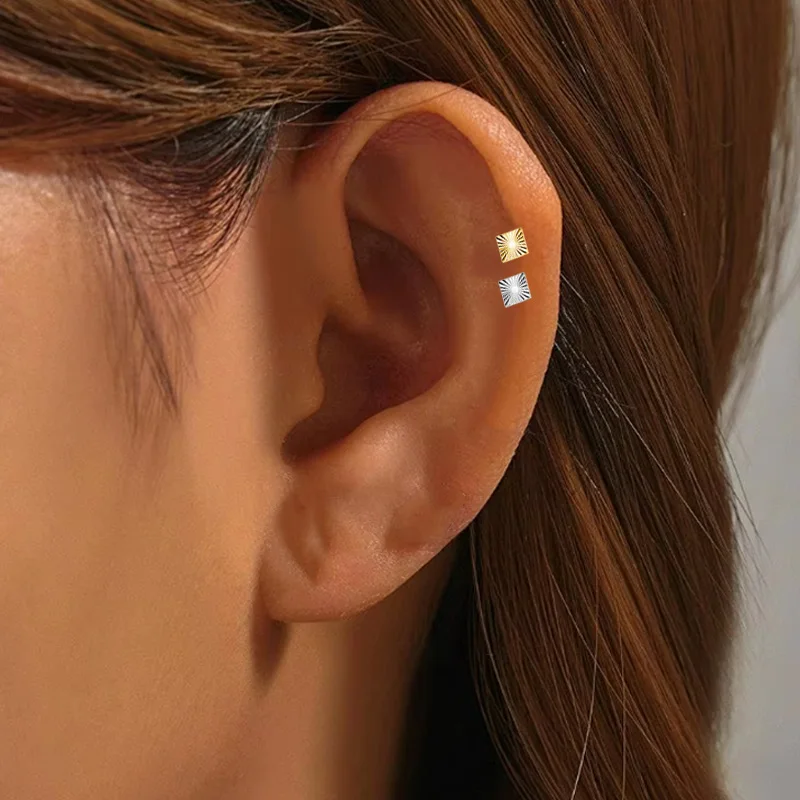
Cartilage earrings are a quiet but important category for professional piercing studios. They sit between daily service jewelry, retail add-ons, and premium display pieces, which means buyers need more than a few attractive designs. A strong cartilage earring line should be easy for staff to recommend, simple to reorder, and broad enough to support different client budgets without creating unnecessary inventory pressure.
For B2B buyers, the goal is not to chase every new shape in the market. The better approach is to build a repeatable product line around reliable materials, practical sizing, proven silhouettes, and clear price tiers. PSS works with piercing studios, distributors, and private-label buyers who need cartilage styles that can be reordered season after season, not just sampled once for a trend board.
Start with the Role Cartilage Earrings Play in the Studio
Cartilage jewelry often has two jobs. First, it supports professional piercing services where material choice, comfort, and fit matter. Second, it helps the studio generate repeat retail sales when clients return for styling updates, downsizing, or additional ear projects. That makes cartilage earrings different from one-off fashion accessories. They need to feel current, but they also need a stable base of sizes and finishes.
A working assortment usually includes simple studs, flat-back labret styles, small decorative tops, hoops, clicker-inspired looks, and a few premium pieces. The exact mix depends on the studio’s positioning. A high-end appointment studio may give more space to 14K cartilage earrings, while a distributor serving many resellers may need a wider commercial range in 316L and titanium. The important point is to define the role of each price tier before placing a bulk order.
Use ASTM-F136 Titanium as the Professional Core
For many professional buyers, titanium cartilage earrings are the most useful foundation. ASTM-F136 titanium is commonly requested by studios because it supports long-wear piercing jewelry programs and allows buyers to build a clean professional range without relying only on decorative plating. It also fits well with flat-back and labret-based cartilage styling, where comfort and repeat sizing are important.
When planning a titanium range, keep the first order disciplined. Start with proven shapes such as small CZ, bezel, prong, star, heart, ball, and minimal geometric tops. Add color finishes only when the buyer knows the local demand. If every style comes in too many colors and sizes, the shelf looks rich but reorders become difficult. A tighter titanium core is usually easier for staff to explain and easier for purchasing teams to replenish.
Studios that already buy titanium threadless labrets can connect cartilage earrings with the same material story. This helps the counter team present titanium as a consistent professional category rather than a single isolated item.
Keep 316L for Commercial Range and Price Coverage
316L stainless steel still has a place in cartilage assortments, especially for buyers who serve retail stores, online sellers, or studios with a broader budget range. A smart 316L piercing jewelry program can cover trend-led shapes, seasonal pieces, and larger design variety without pushing the whole range into premium price points.
The key is to separate 316L’s role from titanium’s role. Titanium can anchor the professional core, while 316L can expand visual choice and price accessibility. For buyers interested in lifestyle claims such as water resistance, the 316L waterproof cartilage earrings category can also support repeat retail positioning. Avoid making broad promises about every finish. Instead, ask suppliers for material, plating, finish, and care details so your sales team can describe the range accurately.
Add Premium Pieces Without Overloading Inventory
Premium cartilage earrings can lift the perceived value of the whole display, but they should be selected carefully. For many studios, a small group of 14K gold pieces works better than a large and slow-moving luxury wall. Butterfly, flower, star, bezel, and small charm designs can be useful because clients understand them quickly, and staff can style them with existing ear projects.
For giftable or fashion-forward collections, 925 silver cartilage earrings can add another tier. Silver is often more relevant for retail display and accessory purchasing than for every piercing service use case, so buyers should position it clearly. Treat 14K and 925 silver as premium or lifestyle additions, not replacements for the professional service core.
Plan by Gauge, Length, Top Size, and Closure System
The most common sourcing mistake is choosing cartilage earrings only by front design. For professional use, the back structure, gauge, length, top size, and closure system matter just as much. A beautiful top is not useful if the post length does not match the studio’s fitting habits, or if the closure system is unfamiliar to staff.
Before ordering, create a simple specification sheet for the category. List the gauges you want to carry, the post lengths you expect to reorder, the top sizes that sell best, and the closure systems your team can handle confidently. Include notes for threaded, internally threaded, threadless, flat-back, hoop, and clicker-style items. This does not need to be complicated, but it prevents scattered purchasing.
If the same buyer also carries labrets, nose rings, or other ear styling pieces, align the sizing logic across categories. The article on planning a core piercing jewelry assortment is a useful companion because cartilage earrings should not be planned in isolation from the rest of the studio inventory.
Build the First Order Around Reorder Behavior
A good first cartilage order should answer one practical question: which items will you be comfortable reordering every month or every quarter? Buyers often over-sample because the category is visually tempting. That creates a display full of single units but makes it hard to know what actually drives revenue.
A cleaner buying structure is to divide the range into three groups. The first group is core service jewelry, usually titanium flat-back or labret-based pieces. The second group is commercial retail variety, often 316L and waterproof 316L styles. The third group is premium display, such as 14K gold or selected 925 silver designs. Each group should have its own MOQ logic, reorder point, and price band.
For distributors, this structure also helps with catalog presentation. Instead of showing hundreds of cartilage earrings as one long list, you can organize by material, use case, and price level. That makes it easier for studio buyers to build assortments quickly and reduces friction during repeat orders.
Ask Suppliers for More Than Product Photos
Product photos are necessary, but they are not enough for wholesale decision-making. Before committing to bulk cartilage earrings, ask for material descriptions, available gauges and lengths, finish options, packaging possibilities, sample timing, and reorder availability. For custom or private-label programs, also ask whether the supplier can support small design adjustments, logo packaging, barcoding, or SKU planning.
This is where factory-backed sourcing becomes useful. A supplier that understands OEM and ODM work can help buyers avoid a product line that looks good once but becomes hard to reproduce. If you are planning private-label cartilage earrings, connect the discussion with your broader OEM piercing jewelry manufacturing workflow so samples, packaging, and repeat production are considered from the beginning.
Soft Launch, Then Expand Based on Real Demand
Cartilage earrings are ideal for staged buying. Start with a professional titanium core, add enough 316L variety to test style demand, and reserve premium pieces for display impact. After the first sales cycle, expand only where the data is clear. Which top shapes were requested again? Which metal colors moved without discounting? Which post lengths did staff reach for most often? Which designs created confusion or returns?
This feedback loop is more valuable than guessing every trend in advance. It helps studios and distributors turn cartilage earrings into a controlled product line rather than a crowded accessory category. Over time, the strongest assortments are not the biggest; they are the easiest to explain, reorder, and restock.
If you are building or refreshing a cartilage earring program, PSS can help you compare ASTM-F136 titanium, 316L, 14K gold, and 925 silver options for your target buyer segment. Share your preferred materials, quantity range, and packaging needs through the contact page, and the team can suggest a practical wholesale assortment for repeat supply.
