

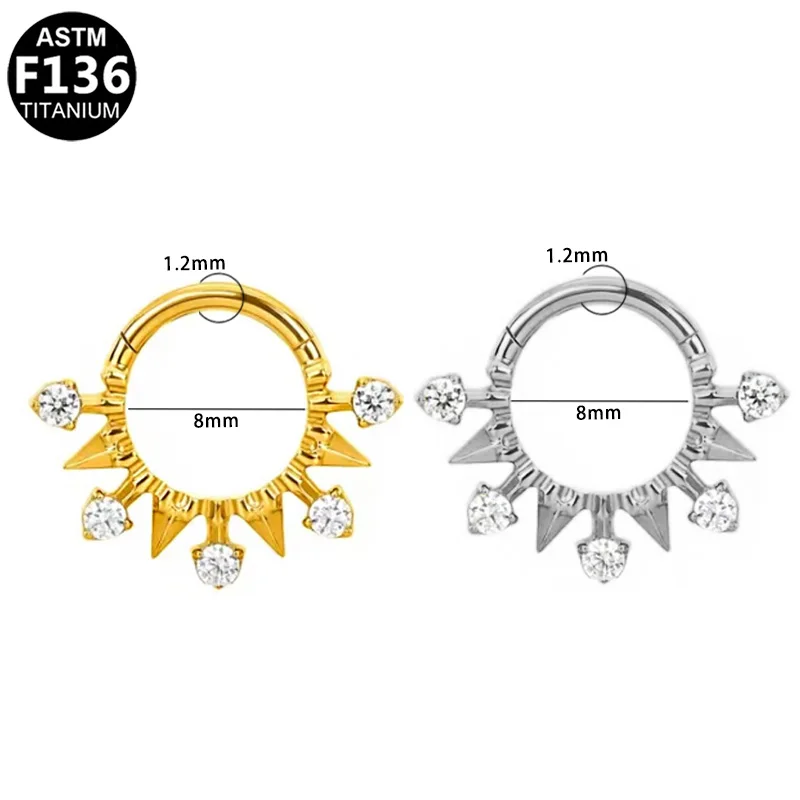
For studios and distributors, septum clickers are more than a trend item. They sit in a useful commercial position: visible enough to attract style-led buyers, small enough for efficient inventory, and flexible enough to support both essential and premium ranges. For a factory-backed supplier like PSS, the goal is not only to offer attractive pieces, but to help B2B buyers build a titanium septum clicker wholesale line that can be reordered, explained clearly, and expanded without creating unnecessary sourcing risk.
The strongest septum clicker assortments usually begin with material clarity. Many professional buyers use ASTM-F136 titanium piercing jewelry as the premium foundation because titanium is lightweight, corrosion resistant, and widely recognized by studios as a suitable material for professional body jewelry assortments. That does not mean every buyer should stock only titanium; a healthy product line can also include 316L piercing jewelry for broader commercial pricing. But when a studio wants a higher-trust septum range, titanium clickers often become the safer buying story.
Why septum clickers deserve their own buying plan
Septum clickers behave differently from simple rings, horseshoes, or captive bead rings. The hinge mechanism, segment alignment, stone setting, surface finish, and diameter consistency all affect how the piece feels in the hand before it ever reaches a display tray. For wholesale buyers, this means selection cannot be based only on the front-facing design. A clicker has to open and close cleanly, sit evenly, and keep the decorative face aligned.
That mechanical detail is why buyers should avoid treating clickers as random fashion add-ons. A better approach is to define a core clicker range by material, gauge, diameter, color, and decoration level. Then add style updates around that structure. This keeps purchasing easier for the buyer, staff training easier for the studio, and repeat ordering easier for the supplier.
Start with the core sizes, then add style tiers
Most B2B assortments work best when the first order is not overloaded with too many variations. For septum clickers, a focused opening range might include a few popular diameters, one or two gauges, polished silver-tone titanium, gold-tone finishes where appropriate, and several visual tiers. The first tier should cover plain or minimal segment clickers. The second tier can include CZ or opal decoration. The third tier can introduce statement shapes, color accents, or seasonal designs.
This type of tiering helps distributors and private-label brands position products across different price points without confusing the line. It also gives studios a simple way to recommend alternatives: understated pieces for daily wear, decorative pieces for customers who want a stronger look, and premium options for curated display sets. Buyers planning a broader titanium line can connect clickers with related categories such as titanium threadless labrets and titanium nose rings so the material story stays consistent across the counter.
Check the hinge and closure before scaling up
A septum clicker may look excellent in product photos and still create problems if the hinge is loose, the segment is hard to align, or the closure feels too weak. Before placing a large repeat order, buyers should test samples in normal handling conditions. Open and close each sample multiple times. Check whether the hinge movement is smooth. Look at whether the decorative front sits centered. Confirm that the closing point is not sharp or visibly misaligned.
For factory communication, it helps to turn those observations into written requirements rather than vague feedback. Instead of saying “better quality,” a buyer can specify that the hinge should close securely, the seam should be visually neat, the decoration should face forward when closed, and the surface should be free from obvious burrs or rough polishing marks. These points are practical, easy to inspect, and relevant to long-term reorders.
Use product photos to reduce buyer hesitation
Septum clickers sell partly through detail. A distributor or studio owner usually wants to see the front design, side profile, closure area, and finish tone. If the product page only shows one angle, buyers have to guess too much. Good photo planning reduces that friction. Ask for clean white-background images, close-ups of stone setting or decorative detail, and at least one angle showing thickness and curvature.
This is especially important for online wholesale pages, where buyers compare many similar products quickly. A strong product page should answer the questions that affect ordering: material, gauge, diameter, available colors, stone type if relevant, finish, packing options, and whether the piece belongs to a broader reorderable series. The same logic applies to private-label development, where photos and spec sheets help internal teams approve products faster.
Think in reorder groups, not isolated designs
The most useful wholesale septum clicker range is usually not one best-selling product. It is a group of related designs that can be reordered together. For example, a buyer might build one polished titanium basics group, one CZ decorative group, one opal-accent group, and one shaped-design group. Within each group, the size and material logic should remain stable even when front designs change.
This makes inventory analysis easier. If a distributor sees that decorative titanium clickers are performing well, they can reorder within the same group and test new faces without rebuilding the entire SKU structure. If a studio sees that plain polished clickers move steadily but colorful pieces move seasonally, they can keep basics in repeat supply and use statement styles as smaller test orders.
Where titanium fits beside 316L and gold-tone options
Professional buyers rarely build a complete body jewelry business from one material alone. Titanium clickers can sit at the premium studio-focused level, while 316L clickers support price-sensitive fashion assortments. Buyers who already stock waterproof 316L piercing jewelry may use titanium as an upgrade path for clients who want a lighter material and a more professional material story. The key is to keep product claims factual: explain material, finish, design, and sourcing consistency without promising medical outcomes.
Gold-tone titanium or PVD-finished pieces can also be useful, but buyers should confirm finish expectations before ordering. Color consistency matters when products are displayed together. If a buyer wants multiple gold-tone styles in one collection, they should ask whether the tones are matched across designs, not just across one SKU. This is a small detail, but it affects how premium the range looks in a tray or catalog.
Questions to send your supplier before ordering
A good inquiry saves time on both sides. Before asking for a quotation, buyers should prepare the target material, gauge, diameter, finish colors, sample quantity, packaging requirement, and expected reorder plan. If the purchase is for a private-label program, add logo, card, pouch, barcode, and carton requirements early. For OEM or ODM development, include reference images and specify which details are inspiration rather than exact copies.
Buyers can also ask whether the supplier can support matching products across a wider titanium line. For example, a studio may want septum clickers, labrets, nose rings, and barbells with a consistent tone and packaging system. A distributor may want a titanium clicker range that can later expand into premium ear and nose categories. Connecting the septum plan to the larger titanium vs 316L sourcing decision helps make that roadmap clearer.
Build the first order for learning, not only volume
For a new titanium septum clicker wholesale program, the first order should create useful sales information. Choose enough SKUs to compare plain, CZ, opal, and shaped designs, but keep the structure simple enough to read results. Track which diameters move fastest, which finishes get reordered, and which designs attract attention but sell slowly. That feedback is more valuable than a large first order full of untested variations.
Once the pattern is clear, buyers can scale the reliable groups and rotate new designs in smaller quantities. This approach supports stable supply, reduces dead stock, and gives the supplier better data for future development. It also gives studios and distributors a stronger purchasing rhythm: core titanium clickers for repeat sales, plus controlled style updates for freshness.
If you are planning a titanium septum clicker line for a studio, distribution catalog, or private-label body jewelry range, PSS can help review material direction, size planning, product grouping, and OEM/ODM options. Share your target market, preferred styles, and expected order structure through the contact page, and our team can suggest a practical starting range for long-term wholesale supply.
